
UAE glossary: Arabic and Emirati words explained
Arabic words turn up everywhere in the UAE, from street names and restaurant menus to small talk at the office. This glossary explains 42 words you are likely to hear, with the Arabic script, a simple transliteration and a short note on how each one is used. Spellings in English letters vary, so you may see the same word written a few different ways. For complete phrases you can say out loud, see our Arabic phrasebook.
| Arabic | Transliteration | Meaning | Note |
|---|---|---|---|
| مرحبا | marhaba | hello | A friendly all-purpose greeting; reply marhaba or ahlan. |
| السلام عليكم | as-salamu alaykum | peace be upon you | The standard formal greeting; the reply is wa alaykum as-salam. |
| وعليكم السلام | wa alaykum as-salam | and upon you be peace | The polite reply to as-salamu alaykum. |
| أهلاً وسهلاً | ahlan wa sahlan | welcome | Said to guests and customers; often shortened to ahlan. |
| شكراً | shukran | thank you | Reply with afwan (you’re welcome). |
| عفواً | afwan | you’re welcome; excuse me | Used after thanks, or to get past someone politely. |
| من فضلك | min fadlak / min fadlik | please | Fadlak to a man, fadlik to a woman. |
| كيف حالك | kayf halak / kayf halik | how are you? | Halak to a man, halik to a woman. Usual answer: alhamdulillah. |
| الحمد لله | alhamdulillah | praise be to God | Said when asked how you are, or after good news. |
| يلا | yalla | let’s go; hurry up | Heard everywhere, from taxis to offices. |
| إن شاء الله | inshallah | God willing | Used for any future plan; can be sincere or a soft maybe. |
| ما شاء الله | mashallah | what God has willed | Said to admire something or someone without envy. |
| خلاص | khalas | enough; done; finished | Ends a discussion or signals a task is complete. |
| حبيبي / حبيبتي | habibi / habibti | my dear (to a man / to a woman) | Affectionate among friends; tone matters. |
| يعني | yaani | I mean; like | A common filler word in conversation. |
| والله | wallah | I swear by God | Adds emphasis, often casually. |
| بكم | bikam | how much? | Useful in souqs and markets. |
| مجلس | majlis | sitting room; gathering place | A traditional space where guests are received and community matters are discussed. |
| سوق | souq | market | Traditional markets such as the Gold Souk and Spice Souk in Dubai. |
| عبرة | abra | small wooden water taxi | Crosses Dubai Creek between Bur Dubai and Deira for a small fare. |
| داو | dhow | traditional wooden sailing boat | Once used for trade and pearling; now also for dinner cruises. |
| وادي | wadi | valley or dry riverbed | Can flood after rain; popular for hiking. |
| جبل | jebel (jabal) | mountain | As in Jebel Jais and Jebel Hafeet. |
| فلج | falaj | traditional irrigation channel | Ancient water channels, notably in Al Ain, listed by UNESCO as part of the Al Ain cultural sites. |
| برستي | barasti | palm-frond hut | Traditional summer housing made from palm leaves. |
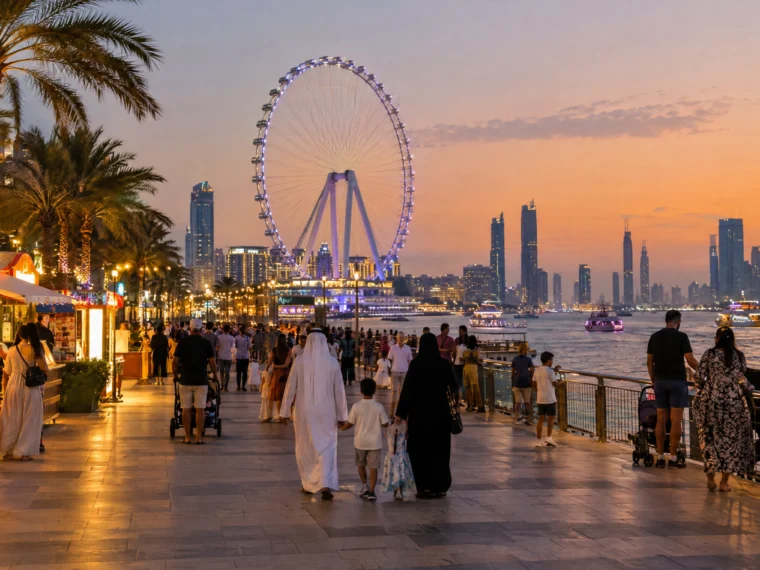
| كندورة | kandura | men’s ankle-length robe | Usually white; also called dishdasha. |
| عباية | abaya | women’s long cloak | Usually black, worn over clothing. |
| شيلة | sheila | women’s headscarf | Often worn with the abaya. |
| غترة | ghutra | men’s headdress cloth | White or red-checked, held in place by the agal. |
| عقال | agal (iqal) | black cord holding the ghutra | Worn as a doubled loop on top of the head. |
| بشت | bisht | formal cloak | A sheer, gold-trimmed cloak worn over the kandura on formal occasions. |
| قهوة | gahwa | Arabic coffee | Lightly roasted, spiced with cardamom; served in small cups as a sign of hospitality. |
| دلة | dallah | traditional coffee pot | A national symbol, shown on the 1 dirham coin. |
| لقيمات | luqaimat | sweet dumplings | Fried dough balls drizzled with date syrup; popular in Ramadan. |
| هريس | harees | wheat and meat porridge | Slow-cooked dish served at Ramadan, Eid and weddings. |
| مچبوس | machboos | spiced rice with meat or fish | A signature Emirati dish. |
| إفطار | iftar | meal that breaks the fast | Eaten at sunset during Ramadan, often starting with dates and water. |
| سحور | suhoor | pre-dawn meal | Eaten before the fast begins during Ramadan. |
| رمضان كريم | Ramadan Kareem | generous Ramadan | Common Ramadan greeting; reply Allahu akram. |
| عيد مبارك | Eid Mubarak | blessed Eid | Greeting for Eid Al Fitr and Eid Al Adha. |
| إماراتي | Emirati | a UAE national; from the UAE | Used for people, food and culture. |
| شيخ / شيخة | sheikh / sheikha | title for a male / female member of a ruling or notable family | Also used for respected elders and religious scholars. |
Spellings and meanings follow common usage in the UAE. Further reading: Essential Arabic phrases, Visit Dubai and New in Dubai? 20 everyday Arabic phrases every expat learns (Gulf News, Aug 2026).
Frequently asked questions
Do I need to speak Arabic to live in or visit the UAE?
No. English is widely used in shops, offices and on road signs, so you can manage without Arabic. Learning a few greetings like marhaba and shukran is still appreciated and makes daily life friendlier.
Why are Arabic words spelled differently in English?
There is no single official way to write Arabic in English letters, and some Arabic sounds have no exact English match. That is why you may see souq or souk, and jebel or jabal. The Arabic script is the reliable version.
What does inshallah really mean?
It means God willing and is used for any plan in the future. Often it is a sincere hope, but in casual talk it can also be a polite maybe, so the context tells you which.