

How to Make Better V60 Coffee at Home in the UAE
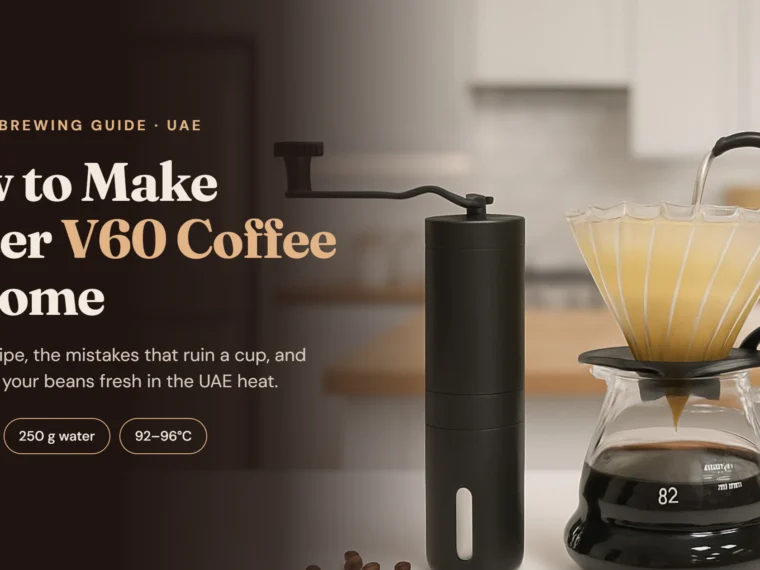
A beginner guide to brewing V60 pour-over at home: the gear you need, a simple 15 g to 250 g recipe, how to fix sour or bitter cups, and how to store beans in UAE heat.
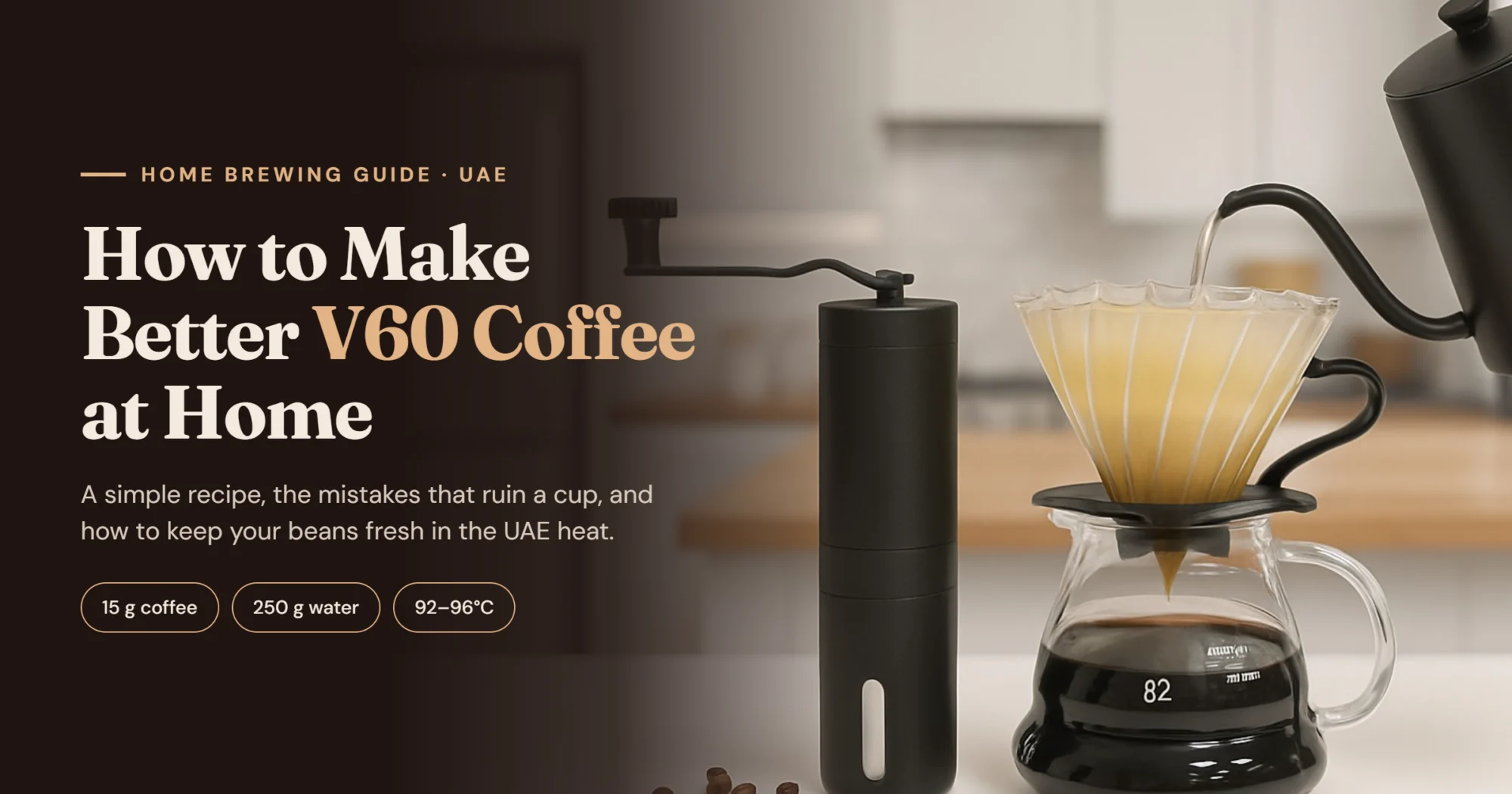
Highlights
- The starter recipe uses 15 g of coffee, 250 g of water, a medium-fine grind and water at 92 to 96°C.
- A bloom of about 45 g of water for around 40 seconds comes first, then pours up to 150 g and 250 g, finishing in 2:30 to 3:30 minutes.
- Sour, thin cups usually mean a finer grind is needed, and harsh, bitter cups a coarser one, changing one thing per cup.
- Store whole beans in a sealed tin in a cool, dry cupboard, away from the stove and never in a hot car.
My first V60 at home was sour. Not “bright and fruity” sour. Sour sour. I’d bought the beans from the same café where I’d had a lovely cup that morning, so I couldn’t even blame the coffee. It was me.
Maybe yours came out bitter instead. Or so weak you started wondering whether you’d forgotten half the coffee. Pretty much everyone who tries pour-over at home hits one of these in the first week, so you’re in good company.
The V60 itself is about as simple as coffee gets. A cone, a paper filter, hot water. Nothing to plug in, nothing to descale, and it lives in a drawer, which in a Dubai flat with a counter the size of a chopping board is a real selling point. The catch is patience. You have to learn what the grind and the pour are doing to the taste, and that takes a few mornings.
What it actually is
Hario, a Japanese company, makes it. The name is literal: V for the shape, 60 for the angle of the cone.
Filter in, coffee in, pour water slowly, coffee drips into the cup underneath. Honestly that’s the whole idea. The fiddly part is the water. Pour too fast, grind wrong or guess your amounts, and every cup comes out different. Took me longer than I’d like to admit to work that out.
Because the paper traps the fine bits and some of the oil, the coffee tastes clean and quite light, and that’s when you notice flavours you’d never pick up in a latte. Chocolate, nuts, citrus. Once I even got something floral from an Ethiopian coffee, which surprised me more than it should have.
Gear
You’ll see people with three kettles and a refractometer. Ignore them for now.
A dripper and the filters that fit it, decent fresh beans, some kind of grinder (burr, adjustable, if the budget stretches), a kettle, a mug or small jug, and a kitchen scale. Your phone does the timing.
The gooseneck kettle question comes up a lot. Yes, the thin spout makes slow pouring easier. No, you don’t need one on day one. Use what you have. The scale is the thing I wouldn’t skip, because spoons are hopeless. My “two spoons” were never the same two spoons twice.
If you don’t own a grinder yet, a local roaster will grind beans for V60 if you ask. It’s not ideal, you can’t tweak it later, but it’s a perfectly good way to start.
The recipe I’d hand a friend
- Coffee: 15 grams
- Water: 250 grams
- Grind size: Medium-fine
- Water temperature: 92–96°C
- Target brewing time: 2:30–3:30 minutes
That works out at roughly a gram of coffee for every 16.7 grams of water. Stick with it until you’ve got a reason not to.
Put the filter in and run some hot water through it first. That washes out the papery taste and warms the dripper up, which matters with ceramic because it stays cold forever otherwise. Chuck that water.
Grind your 15 grams, tip it in, give it a gentle shake so it sits flat. Dripper and cup go on the scale, scale goes to zero.
Now start the timer and pour about 45 grams, just enough to soak all the grounds, and leave it alone for around 40 seconds. It’ll probably puff up and bubble a bit. That’s the bloom, gas from roasting finding its way out. Very fresh beans tend to bloom more. Not always, though.
After that, slowly bring it up to 150 grams. Short pause. Then on to 250. Keep the stream gentle and go round in little circles instead of pouring into one spot, then let it drip through.
It’ll usually finish somewhere between two and a half and three and a half minutes. If yours is a bit quicker or slower, don’t panic. Taste it.
And do taste it properly. Give it a swirl, wait a minute so it’s not scalding, then sip. Is it sharp? Does a bitterness hang about after you swallow? Or is it actually nice? I keep a note on my phone with what I did and how it tasted. It looks a bit obsessive. It works.
Why it sometimes tastes awful
Nine times out of ten it’s grind, extraction, or measurements that wandered.
Sour and thin? Probably under-extracted, meaning the water didn’t get enough out of the coffee. Go a little finer.
Harsh, really bitter? Could be over-extracted, so try a little coarser. Some beans are just bitter by nature, though, and no grind setting will fix that.
Water temperature changes things as well, since hotter and cooler water pull different amounts out of the grounds.
The mistake I made (and I see friends make it constantly) is fixing everything at once. Sour cup on Monday, so on Tuesday it’s more coffee, hotter water and a finer grind. Tuesday’s cup is better. Great. Which change did it? No idea. One change per cup is slow and a bit boring, but it’s the only way you actually learn anything.
Choosing beans
Go into a specialty café in Dubai or Abu Dhabi and you’ll usually find beans from a handful of countries. One bag promises chocolate and caramel, the next one berries and jasmine. Those are tasting notes. Flavors you might notice. Nobody’s added berries to the coffee.
Starting out, I’d go for a medium roast. They tend to sit nicely between sweet, acidic and full-bodied. Light roasts are brighter and fruitier, dark roasts taste more of the roast itself. But really, buy the one that sounds good to you. Whoever on the internet says light roast is the only proper choice isn’t the one drinking it.
Small bags are your friend. At 15 grams a cup, 250 grams gets you about 16 cups, enough to practice properly without being stuck with a kilo of something you don’t like.
The water thing nobody mentions
Your cup is mostly water. Obvious when you say it, but people forget, and what’s dissolved in that water affects how the coffee extracts and how it tastes.
In the UAE you might be using bottled water, a filter jug, or the building’s supply if it’s well looked after. They’re not all the same. You don’t need special coffee water, just clean water you’d happily drink on its own.
Coffee keeps tasting flat or a bit off? Try a different water and give it a few brews before you judge. If you switch water, beans and grind in the same week, you’re back to guessing again.
Heat, and where to keep your beans
This bit is very UAE. Roasted coffee slowly loses its smell and flavor, and heat, humidity, air and sun all make that happen faster.
Mine used to sit next to the stove because it was handy. Bad idea. A sealed tin in a cool, dry cupboard is fine for most kitchens, ideally somewhere the temperature stays fairly steady. And don’t leave a bag in the car in July. You’d think nobody would. People do.
Whole beans last better than ground, so grind right before brewing if you can. If you only brew a couple of times a week, buy smaller bags rather than a big one that goes stale in the cupboard.
Four habits that wreck a good cup
Even people who’ve brewed for years still do these.
- Twiddling the grinder every morning without writing down the setting. You’ll make a brilliant cup one day and never manage it again.
- Pouring too aggressively. A fast, splashy pour stirs up the grounds and the water runs through unevenly. Gentle does it.
- Getting lazy with measuring. A gram or two of coffee, or a splash more water, changes the strength and taste more than you’d expect.
- Staring at the timer. There’s a belief floating around that a good V60 finishes at exactly 3:00. It doesn’t have to. If it tastes great at 2:45, it’s great.
Small kitchen? Good
The V60 suits flat life really well. No machine hogging the counter. Dripper, filters and a little scale go in one drawer, and if it’s usually just you drinking coffee, it’s ideal.
Cleaning is about a minute. Filter and grounds in the bin, wash the dripper the way the maker says, leave it to dry.
Two cups is doable if your dripper and jug are big enough. Doubling everything doesn’t always give the same result though, because a deeper bed of coffee drains differently. You might need to grind a bit coarser or pour differently.
Pro recipes
Plenty of baristas share their methods online. James Hoffmann’s one-cup V60 technique, which is on Hario USA’s website, is a good one to look at. He uses the same 15 grams to 250 grams, with a bloom and then several controlled pours, and it’s a nice way to understand what each stage of the pour is for.
His beans and kettle aren’t yours, though. Use it as a starting point. If a small change gives you a cup you like more, keep the change.
Does it save money?
Depends on how much coffee you drink and what your beans cost. Divide the price of a 250-gram bag by 16 and you’ve got a rough price per cup. Then there’s filters, plus whatever you spent on gear.
If you’re picking up a café coffee most days, brewing at home will probably pay off over time. If it’s a weekend treat, the saving is smaller.
For me it was never really about the money. It’s picking my own beans, making it as strong as I want, and having a proper cup at six in the morning without getting dressed.
A few things people ask me
You don’t need a machine. A dripper, a filter, coffee, hot water and something to drink from, done.
Pre-ground is fine to start with. Ask the roaster to grind it for pour-over. Freshly ground is better, sure, but don’t let not having a grinder stop you.
For water temperature, 92–96°C is a good starting point. After that it comes down to the beans, the roast and your own taste.
And yes, iced V60 works. Brew a stronger coffee straight over a measured amount of ice, using less hot water to allow for the ice that melts.
Where to go from here
Make the simple version. 15 grams, 250 grams. Make it again tomorrow, the same way. If it’s off, change the grind before anything else. Keep an eye on your water and keep the beans out of the heat, especially once summer kicks in.
A few cups in, you’ll start to feel what’s helping and what isn’t. And the day you make one that’s exactly right, write down how you did it. Trust me, that one line in your notes will be worth more than another hour of YouTube.
References & Sources
Frequently asked questions
What is a good starting V60 recipe?
Use 15 grams of medium-fine coffee and 250 grams of water at 92 to 96°C. Bloom with about 45 grams for around 40 seconds, then pour up to 150 grams and finally 250 grams, aiming for a total time of 2:30 to 3:30 minutes.
How should I store coffee beans in the UAE heat?
Keep them in a sealed tin in a cool, dry cupboard with a fairly steady temperature, away from the stove, sun and hot cars. Whole beans keep better than ground, so buy smaller bags if you brew only a few times a week.
Do I need a grinder or gooseneck kettle to start?
No. A local roaster can grind beans for V60 if you ask, and any kettle will do on day one. The article says a kitchen scale is the one item not to skip.
Spotted something out of date? Tell us and we will fix it.